 ChatGPT
 Claude
 Perplexity
 Google AI
How to Build an AI UGC Content System — And Why Distribution, Not Generation, Is the Real Bottleneck
Alex Nguyen, an indie hacker who's grown apps like Notewave and MedDeep to a combined 400K+ users, published an X Article walking through the AI agent stack behind a specific kind of app-marketing content: "brainrot" UGC — short, addictive AI-generated videos designed to get an app in front of hundreds of millions of people organically. His piece, "How to Build an AI UGC/Brainrot System That Can Generate 100M+ Views with Hermes Agent", is a paid partnership with Higgsfield, and it's worth reading in full — but the part that matters most for anyone running content across more than one account isn't the video generation. It's the bottleneck he names explicitly once the system starts working: distribution and feedback start to break down long before generation does.
The pattern: one video format, an army of accounts
Nguyen's starting observation is that a handful of apps — he names Her75 and Looksmaxing — are making tens of thousands of dollars a month purely through organic UGC, with AI-influencer accounts racking up tens to hundreds of millions of views and consistently ranking at the top of the US App Store charts. He then points to the same mechanic showing up in EdTech, the space his own apps grew in: AI-generated videos of university professors "debating and disagreeing about AI" in front of a lecture hall.
The hook format behind the trend Nguyen is describing: a professor "catches" a student using AI, the class reacts, the app gets mentioned in the last three seconds.
The accounts running this format — studyvamp among them — have grown to 71K+ followers and over 10 million likes between them, all pointed at the same product.
The case study: Turbo Learn
The app behind that "influencer army," according to Nguyen, is Turbo Learn — an AI note-taker reportedly doing around $204K/month, built almost entirely on this UGC pattern rather than paid acquisition.
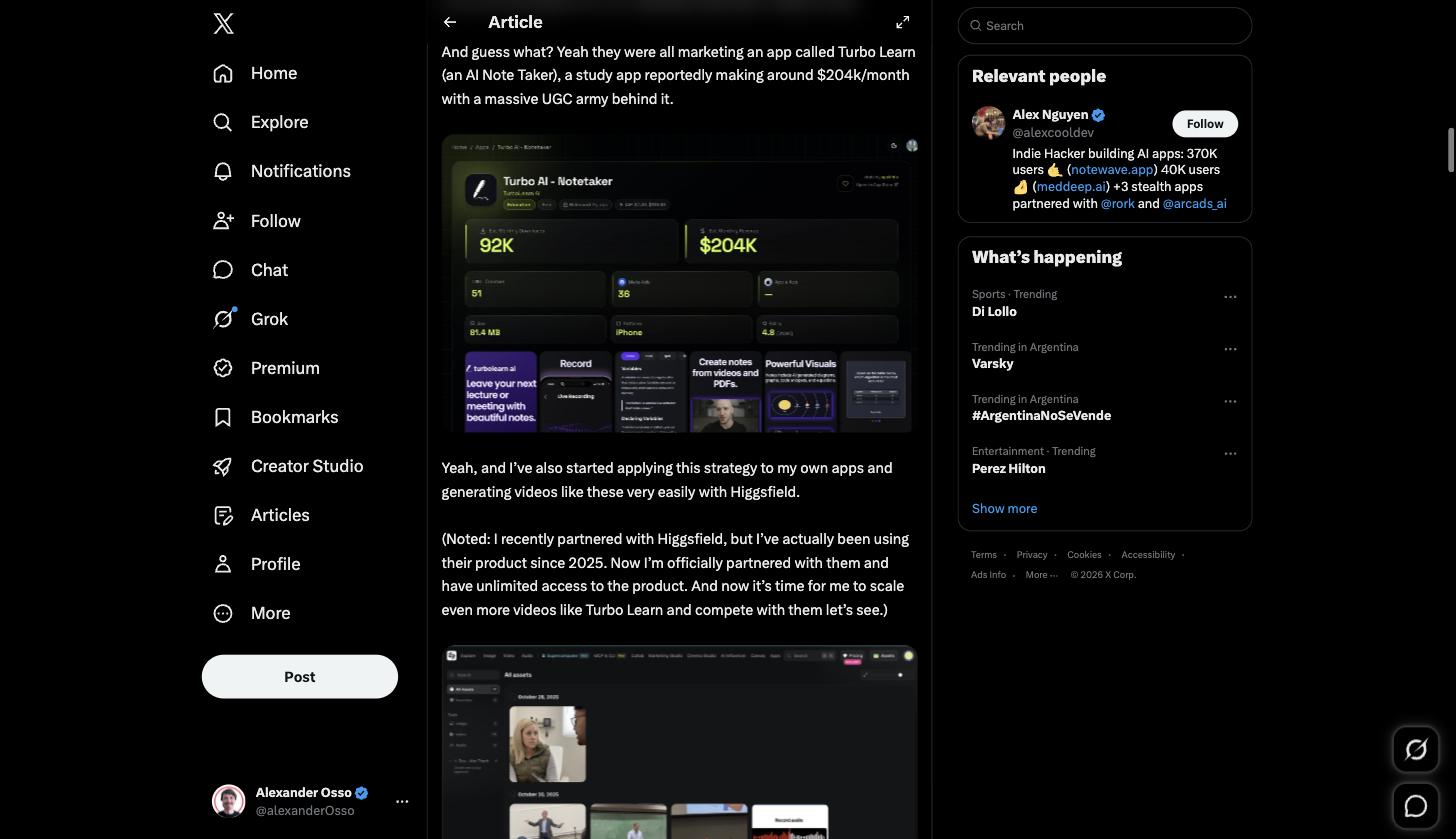
That's the number that makes the rest of the piece worth reading closely: the system isn't a curiosity, it's attached to a real, sizable revenue line.
The stack: Hermes Agent for orchestration, Higgsfield Super Computer for generation
Nguyen says he's been using Higgsfield's video generation since 2025 and has since become an official partner. The specific feature he highlights is Higgsfield's new Super Computer, which takes a detailed scene prompt — camera style, lighting, dialogue, character beats — and renders the video.
But generation alone doesn't explain 100M+ views — one good video isn't a system. That's where he brings in Hermes Agent, an open-source, self-improving AI agent from Nous Research. What makes it relevant here isn't that it generates anything itself; it's that it remembers workflows, builds reusable skills from repeated work, runs scheduled automations, and connects to tools through MCP — including messaging platforms like Telegram, Discord, Slack, WhatsApp, and email.
The workflow Nguyen lays out has six steps: collect winning StudyTok videos from TikTok/Reels/Shorts, extract each one into a reusable prompt template (not a one-off copy), generate dozens of variations across different subjects/personas/hooks, queue the strongest prompts into Super Computer, write multiple caption/CTA angles per video, then feed performance data — views, saves, installs, trial conversion, country split — back into the system so it learns which hooks, subjects, and angles actually convert, not just which ones get views.
The bottleneck he names — and it isn't video quality
Buried partway through the piece is the line that matters most for anyone trying to actually run this: "once you run multiple StudyTok accounts, chaos becomes the biggest bottleneck." His proposed fix is a production queue that tracks, per video, the prompt, the app being promoted, the target persona, the caption, the hashtags, the language, which account it's going out on, and a status (idea → generated → edited → posted → winner/loser). That's not a generation problem. That's a distribution and operations problem — and it's the exact layer PosteAhora's API and MCP server were built to sit under an agent like Hermes.
Where PosteAhora reinforces this exact flow
To be precise about what this is and isn't: PosteAhora didn't build Nguyen's system, and using it doesn't require Hermes Agent or Higgsfield specifically — the same mechanics apply to any agent producing multiple content variations for multiple accounts. What PosteAhora's public API and MCP server do is give an agent the exact production-queue-and-fan-out layer Nguyen describes wanting, without anyone having to build it by hand:
- A queue with statuses, before anything is a real post. PosteAhora's Ideas backlog (
create_idea/list_ideas/update_idea) is a kanban board an agent can drop each variation into — caption, media, and freeform tags (subject, persona, hook type, target account, language) — and move through columns as it's generated, reviewed, and approved, before it ever becomes a live post. It's the same "idea → generated → edited" progression Nguyen describes wanting to track by hand. - One call, many accounts. Once a variation is ready,
create_post(orschedule_postfor a future time) takes anaccountMappingsarray — one entry per connected account, each with its ownplatformandaccountId— so a single agent call can fan the same video out across every StudyTok-style account it runs, withplatformCaptionsoverriding the caption per account when the persona or language differs. This is the "chaos" Nguyen names, handled as one structured call instead of N manual uploads. - Draft by default. Both
create_postandschedule_postdefault tostatus: "draft"— the agent does the generation, captioning, and account-targeting; a human still reviews before anything goes live, the same safety valve worth building into any pipeline that can otherwise post "100 variations" unsupervised. - The feedback loop, automated. Nguyen's step 6 — feed views, saves, installs, and country data back into the system — is exactly what PosteAhora's
get_analyticstool returns: views, likes, comments, shares, reach, saves, impressions, and interactions, aggregated and broken down per platform, synced hourly from each connected account. Because it's exposed over MCP, it's a tool Hermes Agent (which Nguyen already describes as connecting to tools through MCP) can call directly — turning the weekly manual work of pulling numbers and reporting back into a scheduled skill the agent runs itself.
None of this replaces Hermes' actual reasoning about which hooks and personas are working — that's still the agent's job. What it removes is the custom integration work of connecting that reasoning to every social account it needs to post to and pull numbers from.
What's worth copying even if you never touch this exact stack
Treat one winning video as a template, not a one-off — the leverage is in the hundred variations, not the single hit. Track a status per piece of content, not just a folder of files, the moment you're running more than one account. Default new content to a review state before it's live, especially once an agent is producing dozens of variations a week. And close the loop: generation without a feedback path back from real performance data is just content volume, not a system that improves.
Sources
- Original article: Alex Nguyen (@alexcooldev), "How to Build an AI UGC/Brainrot System That Can Generate 100M+ Views with Hermes Agent" — disclosed as a paid partnership with Higgsfield.
- Hermes Agent — open-source, self-improving AI agent from Nous Research.
- Higgsfield — AI video generation platform, including the Super Computer feature referenced above.
Already running an AI agent that produces content variations at scale? Connect your accounts on PosteAhora and let the same agent that generates your videos queue, fan out, and track them across every channel it posts to.