 ChatGPT
 Claude
 Perplexity
 Google AI
The Claude Skill That Replaces a $79/Month Higgsfield Plan — And What It Means for Your Whole Content Pipeline

Jay E, who runs the AI-builder channel RoboNuggets, cancelled his Higgsfield subscription and replaced it with a single Claude Skill. Not a cheaper subscription to a competitor — no subscription at all for the generation part. In his video, "This 1 Claude Skill Fully Replaces Your Higgsfield Subscription", he walks through exactly what that skill does, why Higgsfield's business model is more fragile than it looks once you understand it, and how to build the same setup for your own work.
The core idea generalizes past image generation. It's the same question worth asking about any tool you pay a flat monthly fee for: are you paying for the underlying capability, or for someone else's convenience wrapper around it — and is that wrapper's fee proportional to what you actually use?
What Higgsfield actually is, once you strip away the UI
Jay's argument starts with a reframe: Higgsfield isn't a model — it's an aggregator. It connects to models like Google's Nano Banana and Veo, wires up the API integration work so you don't have to, and sells you access to that aggregation through a monthly plan ($49/month for Plus, $79/month for Max, at the time of the video). There's nothing wrong with that as a business model — aggregation has real value — but it means the $79 you pay every month isn't tied to how much you actually generate. Use a fraction of your quota in a slow month, and you still pay the full $79.
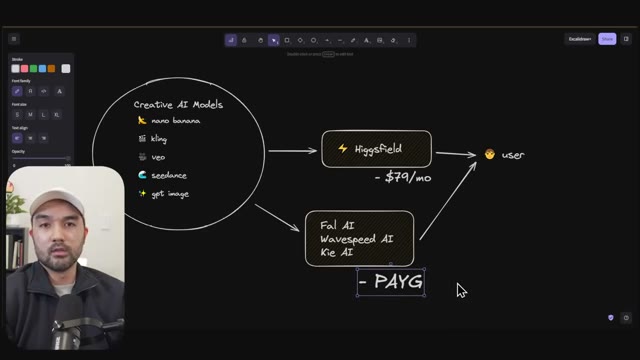
Jay's opening thesis: instead of $100+/month for a wrapper, a Claude Skill that only charges for what it actually generates.
He also points to two concrete friction points that pushed him to look for alternatives: a planned Higgsfield terms-of-use update (since walked back and clarified) around usage rights over generated content, and a deletion window that limits how long you can retrieve your own generations after cancelling — both the kind of lock-in that a pay-as-you-go setup with local storage simply doesn't have. When Jay generates through his own Skill, every image, every prompt used to make it, sits on his own machine, under his own control, for as long as he wants.
The alternative: model aggregators that bill per generation, not per month
Instead of one subscription, Jay's Skill routes to three pay-as-you-go model aggregators — fal.ai, Wavespeed, and kie.ai — each of which does the same underlying job as Higgsfield (one account, one API key, access to hundreds of models) but bills only for what you generate. He walks through the real cost comparison for GPT Image 2 at 2K resolution: roughly 31–34 cents through Higgsfield's plan pricing, versus 5 cents through kie.ai — the same model, the same output, an order of magnitude apart in cost per image, because one of them is amortizing a flat monthly fee across your usage and the other is billing the marginal cost directly.
His own routing preference, for anyone building something similar: kie.ai first when cost matters most (cheapest, occasionally less reliable under load), fal.ai as the default for reliability, Wavespeed when a specific niche model isn't available elsewhere.
Watching the Skill actually work
The demo in the video is a real ad-generation task: a product called Ketone IQ needed image ads for a new flavor launch. Jay's prompt to the Skill included reference images of the brand's past design system, a hard $3 total budget for the generation run, and an instruction to try multiple models (GPT Image 2, Nano Banana 2, Nano Banana Pro) so he could compare results side by side before picking a direction.
The /generate skill invoked with a hard budget cap and a request to compare multiple models on the same prompt — the kind of hard rule Jay says is essential once an agent has the ability to burn through credits unsupervised.
That budget cap matters more than it sounds: Jay is explicit that without a hard-coded spending rule, an agent asked to "generate 100 images" will do exactly that and drain a budget you never meant to spend. The Skill isn't just a routing table — it's also where you encode the guardrails you want every generation to respect.
From there, the same session went further than image generation: Jay picked the ad image he liked, pointed Claude Code at that file, and asked for a full landing page inspired by it — matching colors, an image-to-video animation of the hero shot using Kling, and a few more images in the same style. One prompt, and a working site draft, roughly 70–80% of the way there, built from assets the same pipeline had just generated.
Inside the Skill: routing, budget, prompts, logging, gallery
What actually makes this work as a system rather than a one-off trick is that a Skill is just a written document — instructions Claude follows every time it's invoked, fully customizable to how you work. Jay breaks his own /generate skill into four steps whenever it runs:
- Route the model — check the cheapest available source first (kie.ai by default), fall back to fal.ai, then Wavespeed if the first choice is unavailable.
- Load references and craft prompts — pull in any reference images and style notes, then write the actual prompt sent to the model — inspectable before it fires if you want to review it first.
- Generate — call the routed model's API and get back the media.
- Log — store every prompt actually used, so nothing generated is a black box you can't reproduce or audit later.
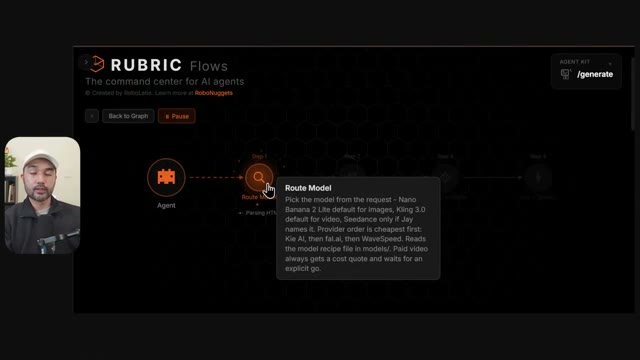
The four-step routing logic inside the skill, and the local gallery where every generation lands automatically — Jay's own answer to Higgsfield's masonry grid.
On top of that, Jay built himself a small local gallery app — a masonry grid, deliberately similar to Higgsfield's own — where every generated image and video lands automatically, along with a "styles" panel that stores prompt-and-reference combos he reuses often (a "cinematic liquid glass" look, in his example) so invoking a known style is a one-click copy instead of rewriting a prompt from memory.
Why this is a template, not just a one-off skill
The part of the video worth taking away even if you never touch Higgsfield: a Skill is, in essence, just a written recipe Claude follows — which means it's fully yours to extend. Jay's own example: to add a newly released model, you go to the aggregator's docs (fal.ai publishes an LLM-readable reference at the top of each model's page), copy that reference text, and tell Claude to fold it into the Skill. No redeployment, no waiting on a vendor's roadmap — the Skill grows exactly as fast as you want it to.
Where this connects to publishing — and what it costs to avoid a subscription there too
Jay's Skill solves the generation half of a content pipeline — the images and videos exist, cheaply, under your own control. The other half is getting that content published, and that's exactly where the same "pay for the plan tier you actually need, not the biggest one" logic applies to PosteAhora.
It's worth being precise here rather than overselling it: PosteAhora's public API and MCP server aren't a free, no-subscription layer — creating an API key or MCP connector requires being on a paid workspace plan, the same way generating through Higgsfield required a plan. What's genuinely comparable to Jay's argument is which plan unlocks that access. API and MCP access ships on every PosteAhora tier, including Standard — $24/month billed monthly, or $16.80/month billed yearly — not gated behind the top plan the way some competitors reserve API access for their most expensive tier. Standard includes one API credential (an API key or an MCP connector); Team, Scale and Agency raise that limit alongside more channels, storage, and analytics depth. You're not paying for a full-featured web app subscription just to get programmatic access — you're paying for the tier that actually matches what an automation needs.
With a key in hand (Authorization: Bearer pah_live_…), the same kind of pipeline Jay built for images extends one step further:
GET /accountsresolves the realaccountIds for each connected channel — the same "know your explicit target, don't guess" principle his Skill follows for model routing.- Generated media (from the Skill's kie.ai/fal.ai/Wavespeed pipeline, or from Higgsfield if you keep it around) gets a hosted URL through PosteAhora's media upload endpoint, which then goes straight into
mediaUrlsonPOST /posts. - That same call sets
status: "draft"for a human review gate, orstatus: "scheduled"with ascheduledAttimestamp to queue it directly —accountMappingslets one call fan a post out across Instagram, X, LinkedIn, and the rest in a single request, each with its ownplatformCaptions/platformOptionsif needed.
Chain that after Jay's /generate skill in one Claude session, and the full loop — generate cheaply, review, publish — runs without renting either an all-inclusive image-gen suite or an all-inclusive scheduling suite you're not fully using.
What's worth copying even if you never touch either tool
- Ask what you're actually paying for. A flat monthly fee is often paying for aggregation/convenience, not the underlying capability — and once you understand the wrapper, you may not need to pay for it at that price.
- Hard-code spending limits into any agent that can burn API credits. "Generate a variety" without a cap is an invitation for an agent to over-generate.
- Keep your own copy. Local storage of what an agent generates — prompts included — means you're never at the mercy of a vendor's deletion window or a terms-of-use rewrite.
- A Skill is a living document, not a one-time build. The moment a new model or capability appears, the fastest path is usually "paste the docs, ask Claude to fold it in" rather than waiting for a vendor's UI to catch up.
Sources and further reading
- Original video: Jay E, "This 1 Claude Skill Fully Replaces Your Higgsfield Subscription" — RoboNuggets
- RoboNuggets on YouTube
- Model aggregators mentioned in the video: fal.ai, Wavespeed, kie.ai
- Higgsfield (the platform being compared against)
Already generating content cheaply with a setup like this? Connect PosteAhora on the Standard plan and let the same Claude session that generates your images publish them too.
Original video and system by Jay E / RoboNuggets — full walkthrough: "This 1 Claude Skill Fully Replaces Your Higgsfield Subscription".